Gusto • Platform design
Gusto Compliance
Helping new employers understand and act on government requirements


Overview
I led the end-to-end design of Gusto’s HR compliance experience: A scalable system that uses machine learning to surface legal obligations to new employers helping small businesses navigate complex government requirements stemmed from hiring.
My role
My role spanned from setting the vision and securing leadership buy-in to executing a cross-product framework adopted by multiple teams. The result: a more coherent experience, and reusable design foundations for future compliance efforts.
Impact
The redesigned PayPal checkout successfully met key objectives and delivered significant value while improving the user experience, enabling business growth and strengthening PayPal's competitive stance:
Credit adoption increase
Credit applications coming from checkout increased from 2% to 6%
Steadily high conversion
Successfully preserved our critical 80% checkout transaction rate
Improved satisfaction
Customer feedback indicated high satisfaction after the redesign.
Challenge and research
By 2024, 70% of new Gusto customers were micro-businesses hiring their first 1–5 employees and my team's business goal was to increase acquisition of HR tools amongst them. However adoption was low. I conducted interviews with 15 new employers and found why:
Hiring was informal
Most new employers recruited via personal networks and did not need our applicant tracking tools or performance management.
New employers craved guidance on compliance, we didn't help
Newer employers felt burdened by complex government requirements when hiring. Worried about penalties, they looked to Gusto for clear guidance and support. However we offered a scattered experience.
Cost drove decisions
SMB owners only acquired tools when absolutely necessary, being extremely cost-conscious.
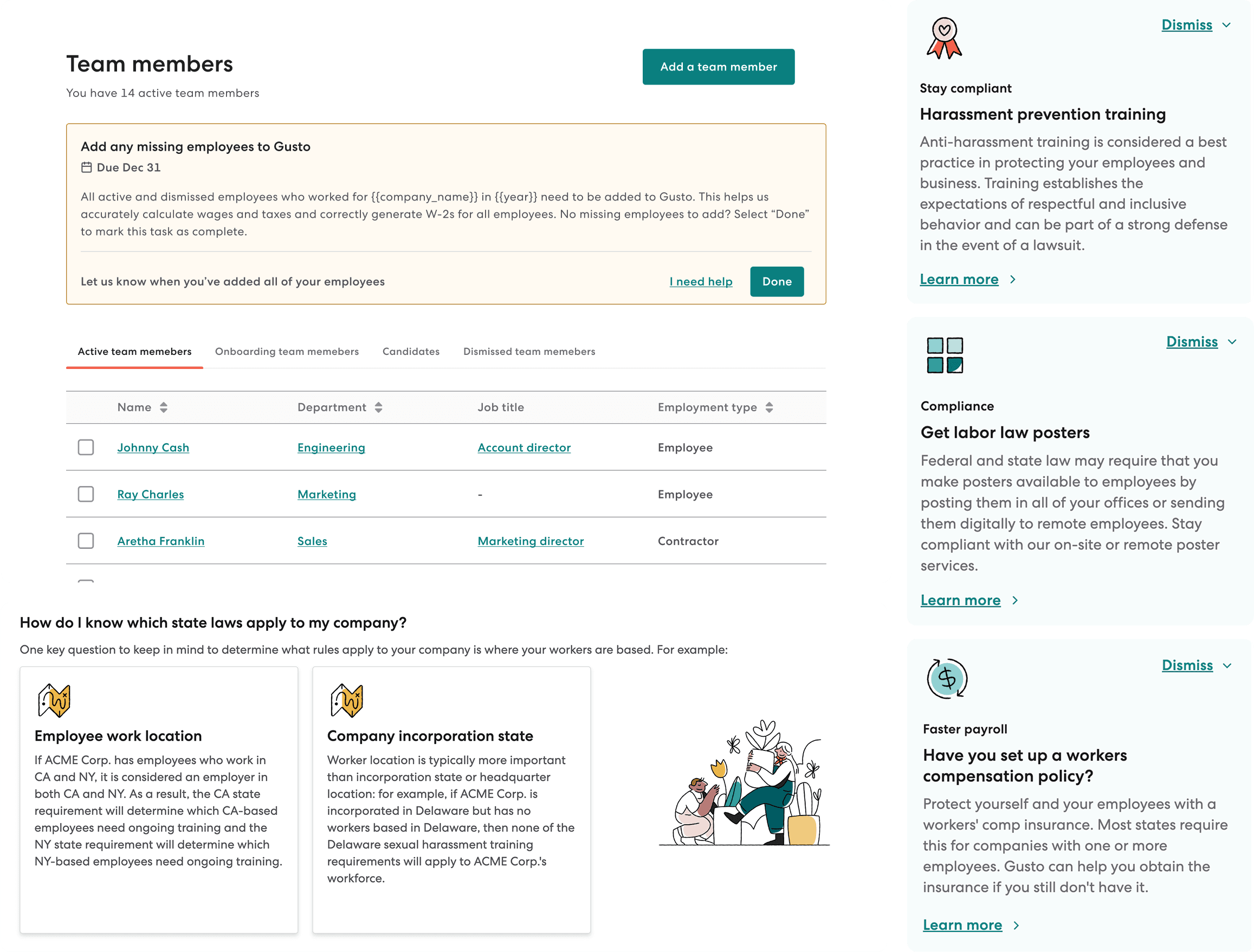
The existing experience was scattered across Gusto using different pattrens.


Defining the framework and where to start
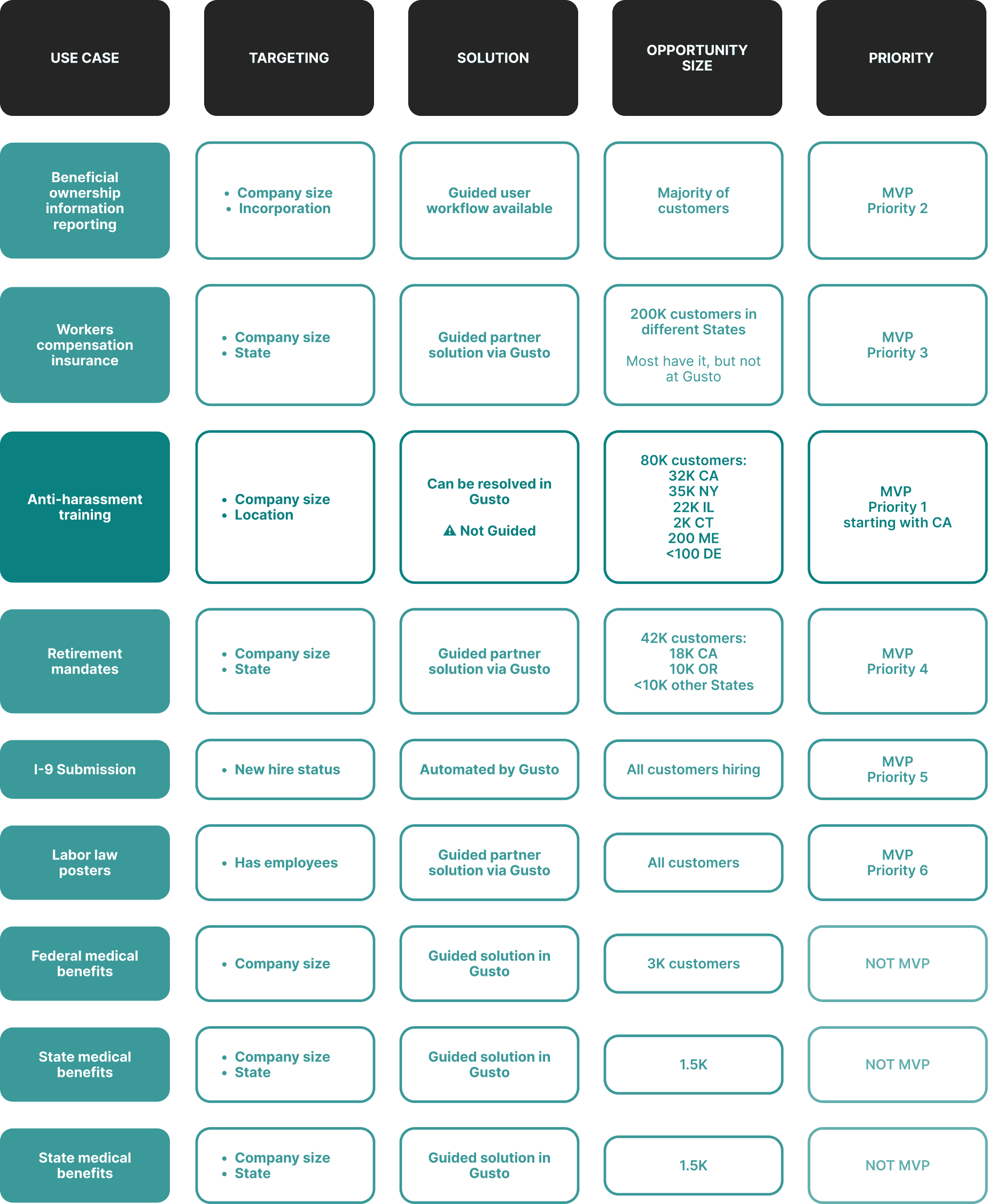
With my PM's input I mapped out the vast arrange of use cases we had to tackle. We decided to start with compliance trainings in California, due to its opportunity size, complexity and Gusto's full control over the experience.
I also worked with engineering to visualize how ML could rank and prioritize compliance tasks.


Strategy Pivot
These insights led to a pivot: Instead of pushing HR tools, we prioritized proactive, contextual compliance guidance with a machine-learning powered platform to surface obligations and guide customers to take action confidently.
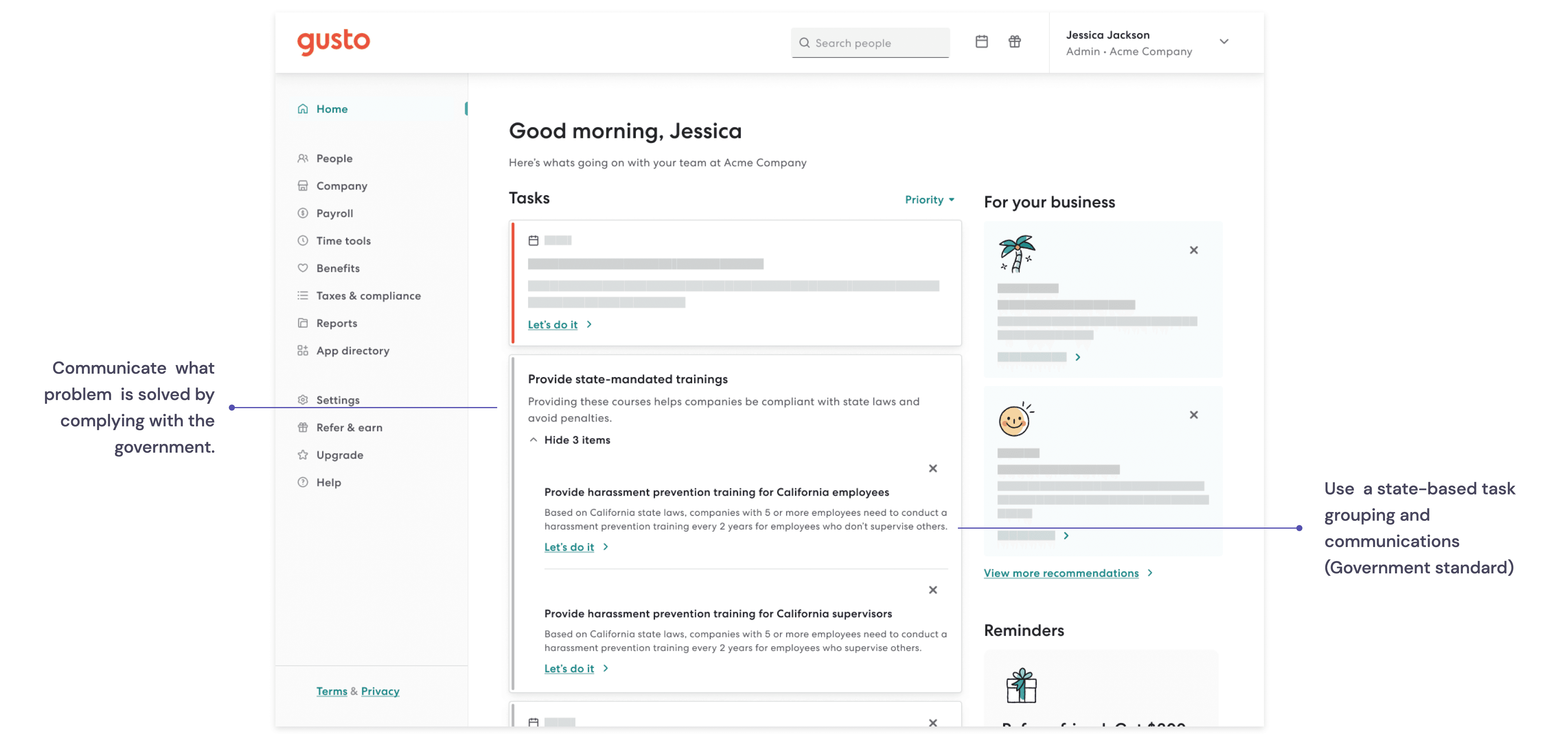
We initially focused on hiring use cases and leveraged the existing notification system for delivery due to its broad reach.
Why
80% of small employers have compliance gaps due to unawareness. They expect Gusto to help them understand and act on government requirements.
What
Build a scalable, centralized alert system across HR, payroll, and benefits.
How
Start with the most pressing use cases and use our home task system for awareness. Then grow from there.
Initial explorations: Compliance awareness
As a lead, I coordinated working sessions with my content writing partner and the designer from our task system. We ran explorations focused on creating core awareness patterns for our compliance experience.
Initially we tried to minimize UI footprint and keep users in the home screen to understand and act on compliance rules. The required real-estate needed to clearly communicate complex compliance rules made us discard this approach.
Compliance in a contextual sheet constrained information delivery
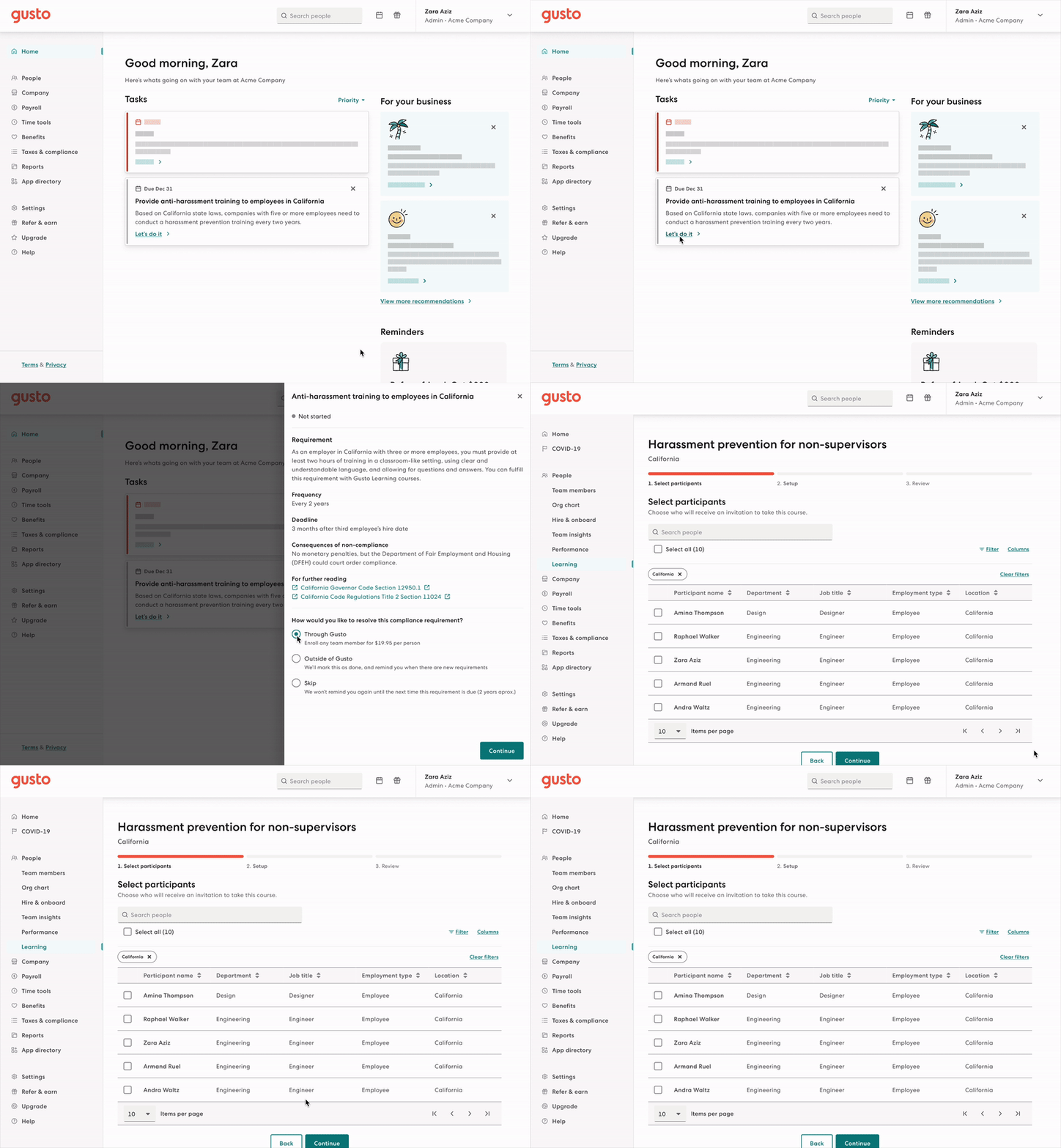


Step by step scaled better and avoided information overload


Emerging design patterns
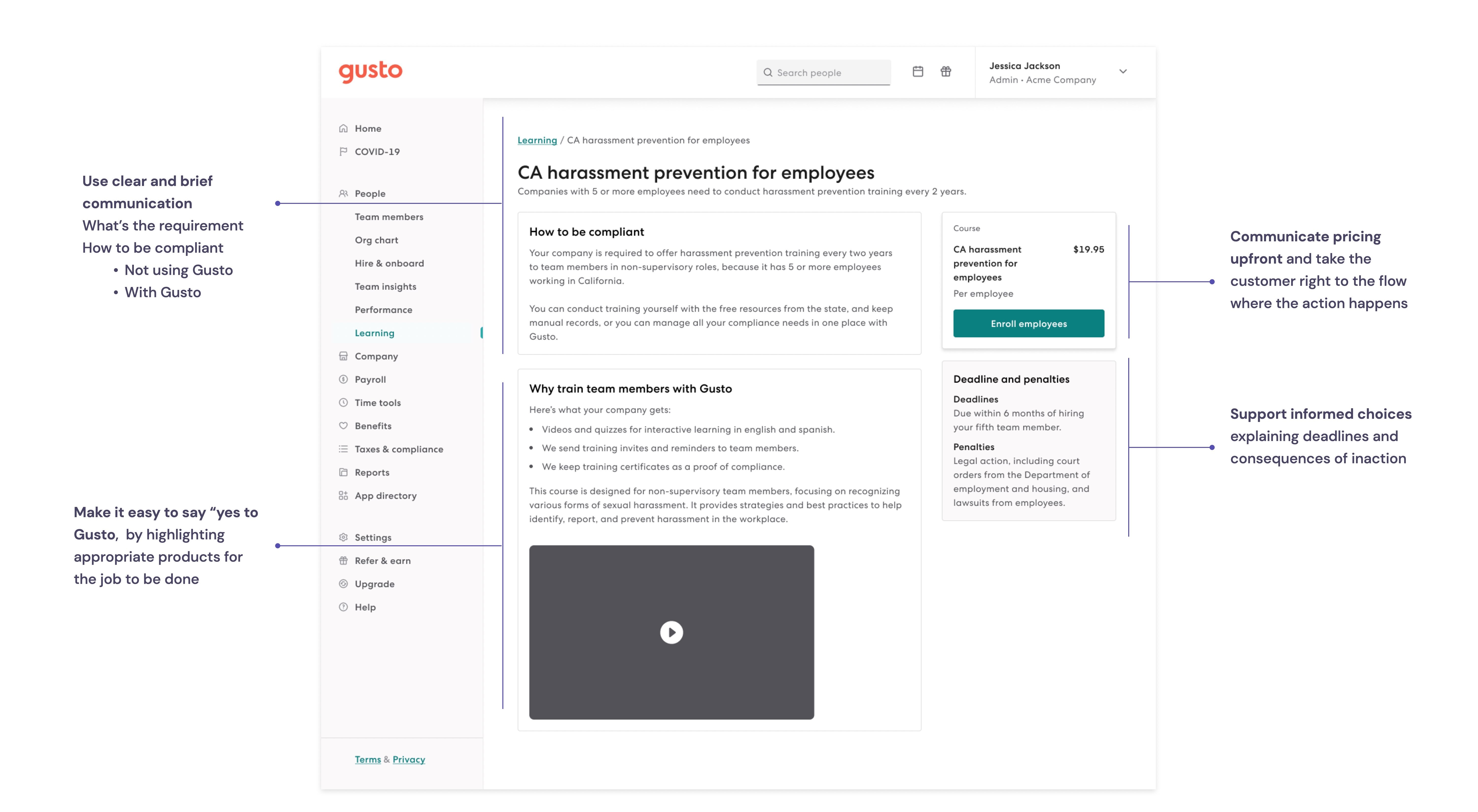
To ensure scalability I partnered with content design to set the tone, principles and patterns: Clear language, visible but not threatening consequences of inaction, driving users to Gusto solutions balanced with transparency on external options.
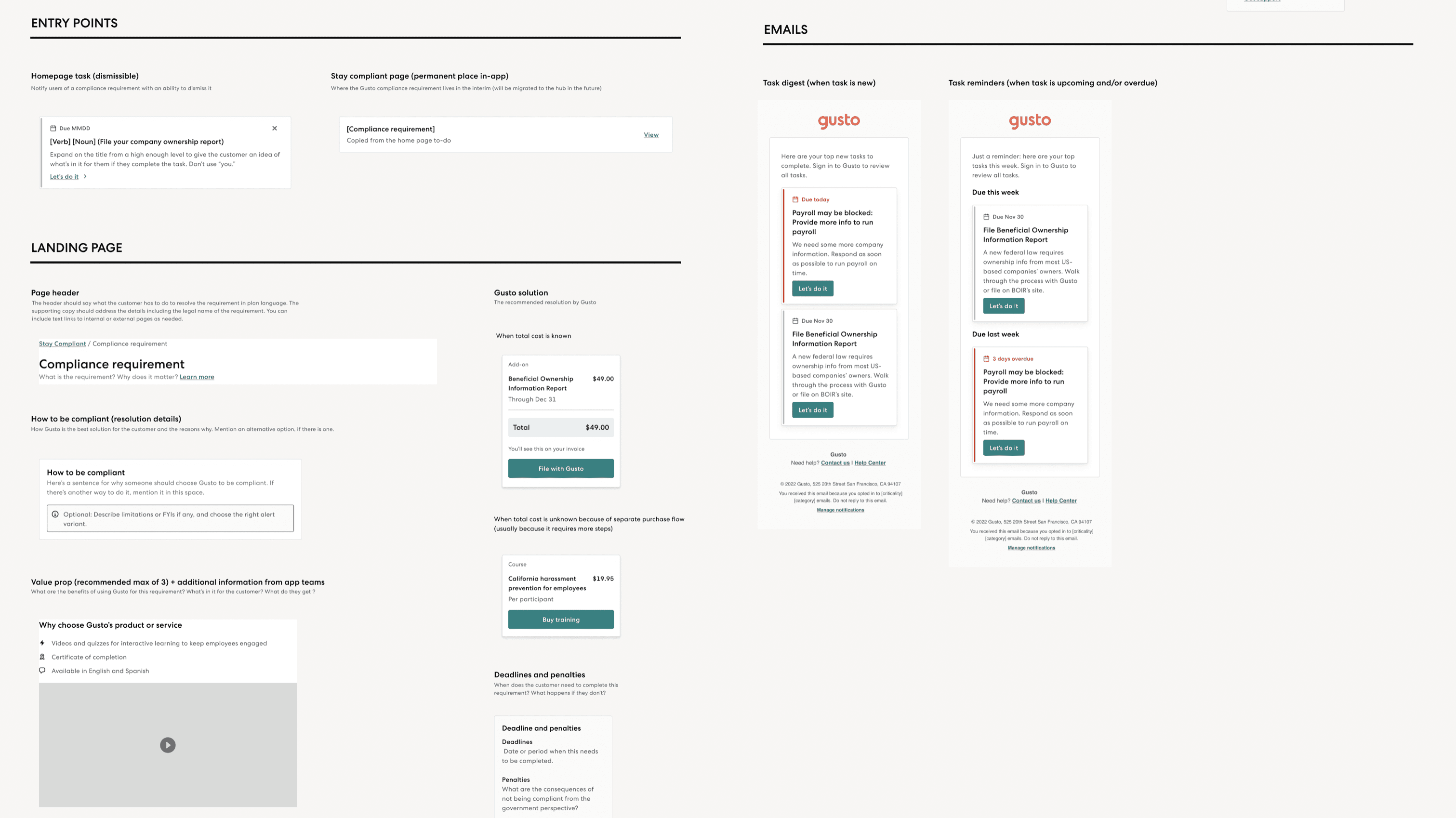
Components & emails
Messaging & emails


Alert communication & principles
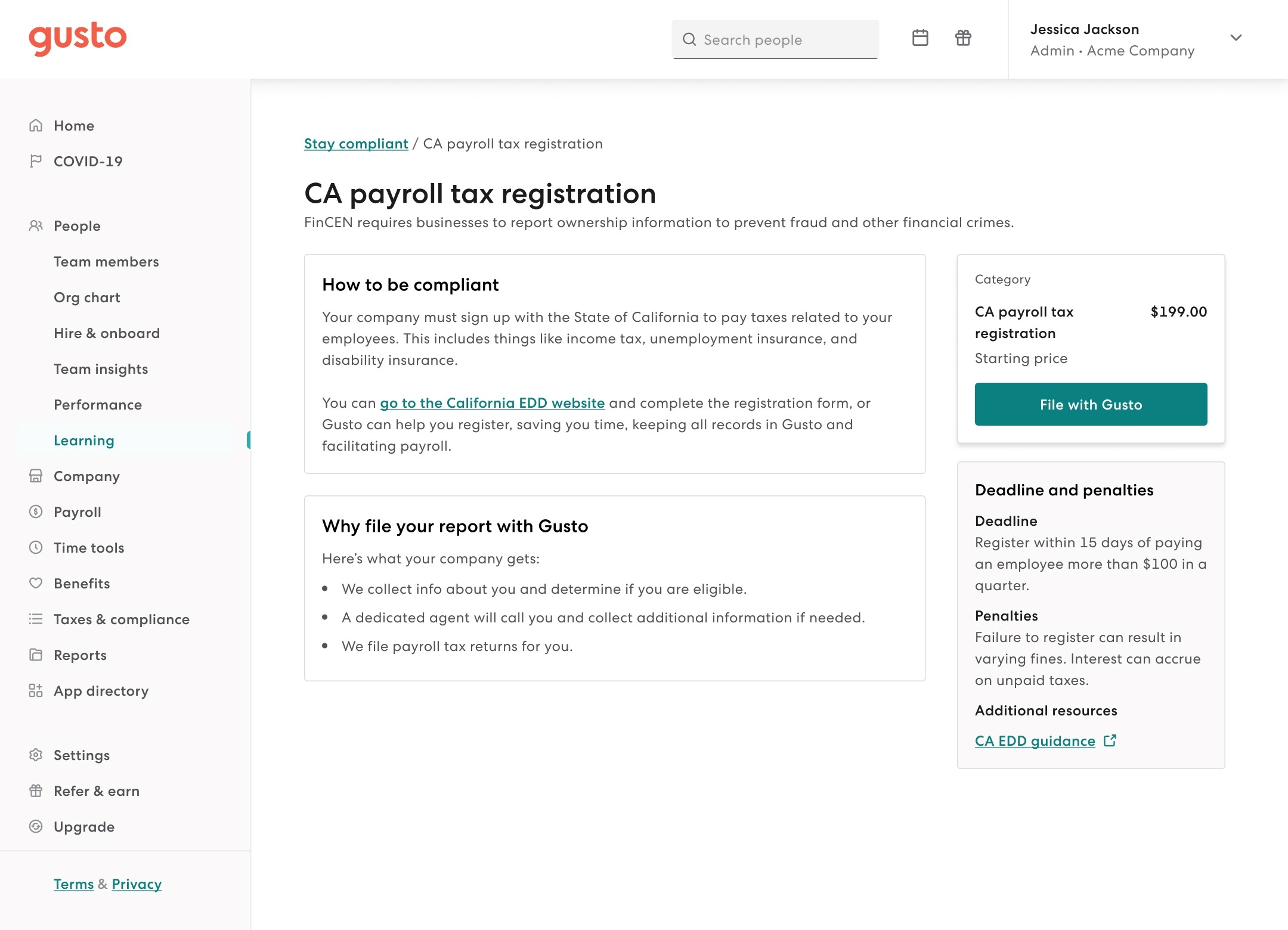
Compliance page and principles
Compliance page
Compliance page and principles


Compliance page and principles
Alert communication principles
Alert communication
Alert communication principles


MVP: Enrolling employees in training
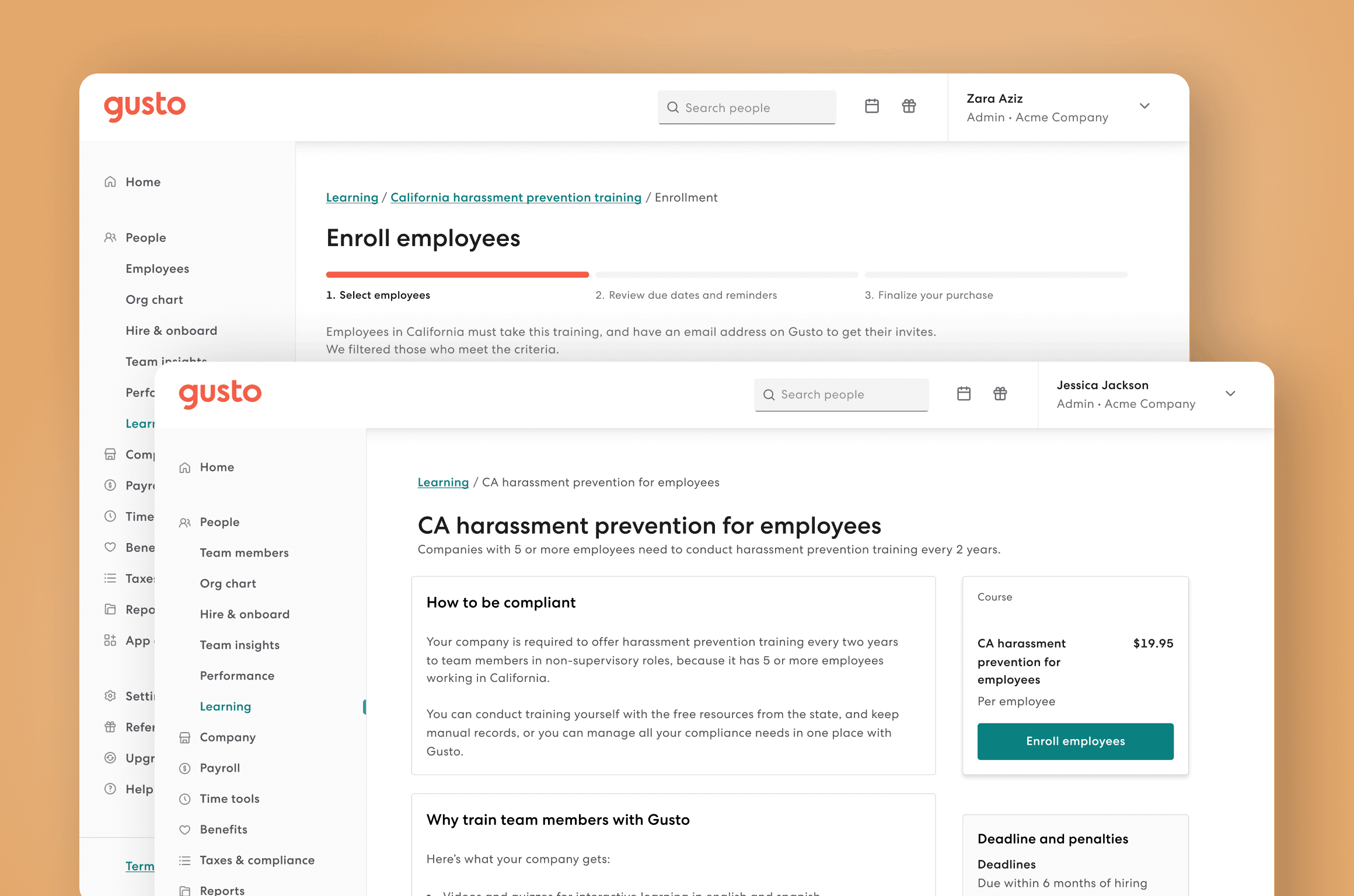
In the final flow, I prioritized a clear and safe experience, highlighting Gusto as the best solution to enroll employees in training. On the employee side, I put emphasis on using email and in-product notifications to remind employees to take trainings, helping companies be fully compliant.
Within three months we consistently saw that 10 out of 12 employers who saw HR training compliance notifications acquired trainings for their employees.
MVP for SMB owners: Compliance awareness and enrollment in training
Experience for employees being trained
Adding more use cases
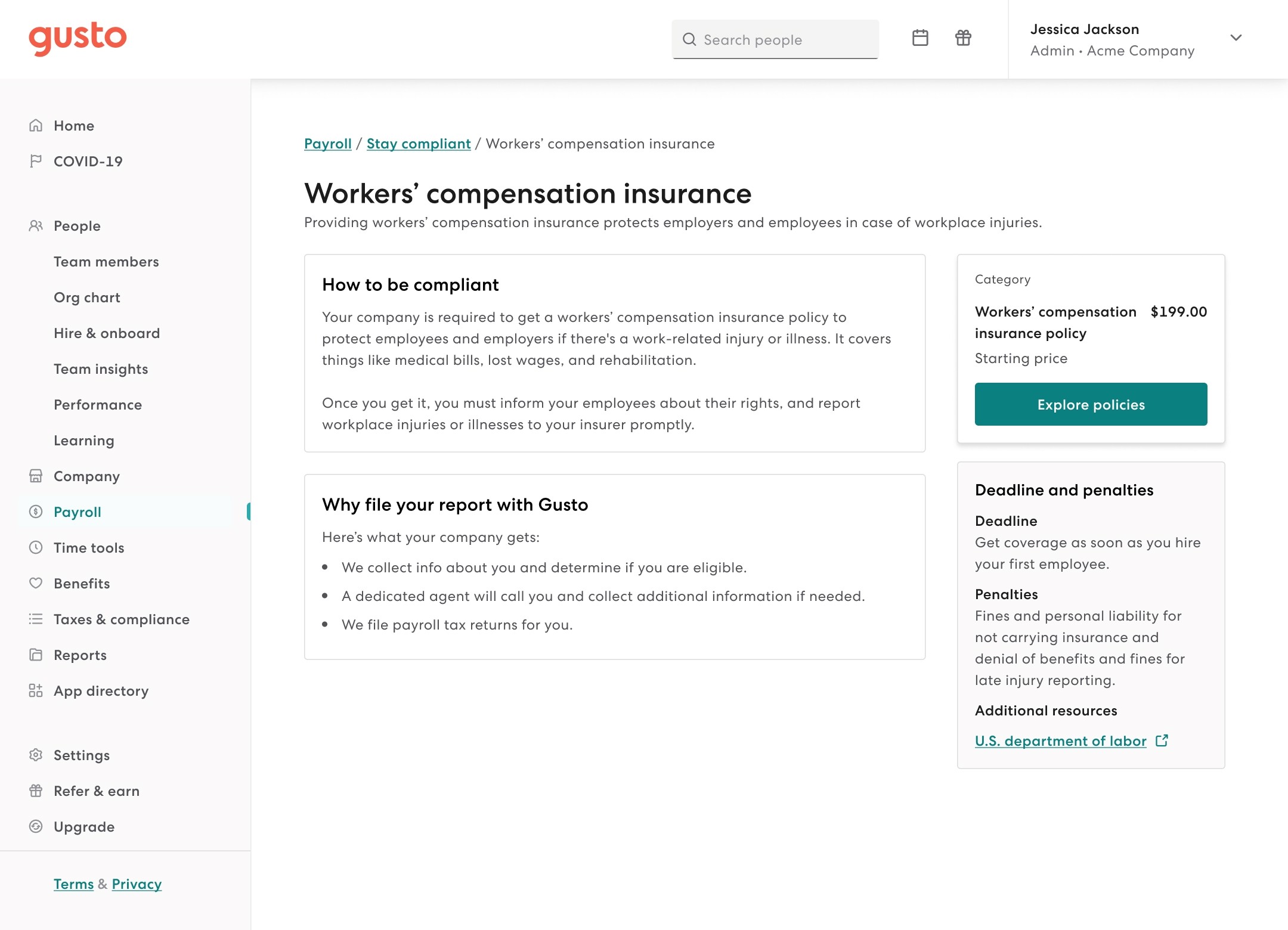
As the project evolved, not only I stress-tested the new compliance page and patterns with multiple teams, but started onboarding the most sought-after use cases with teams like benefits and payroll.
Multiple teams adopting our framework
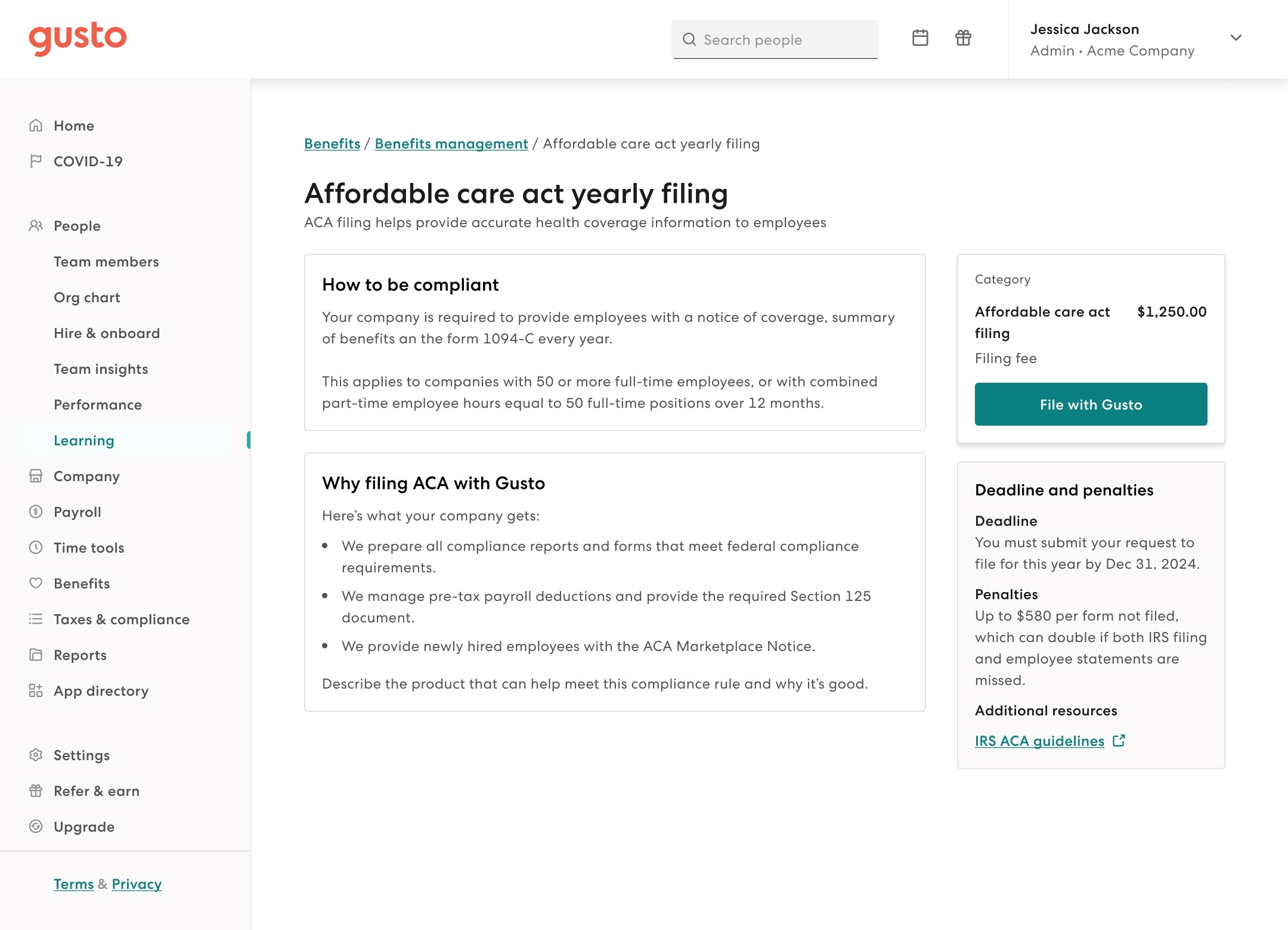


The compliance hub
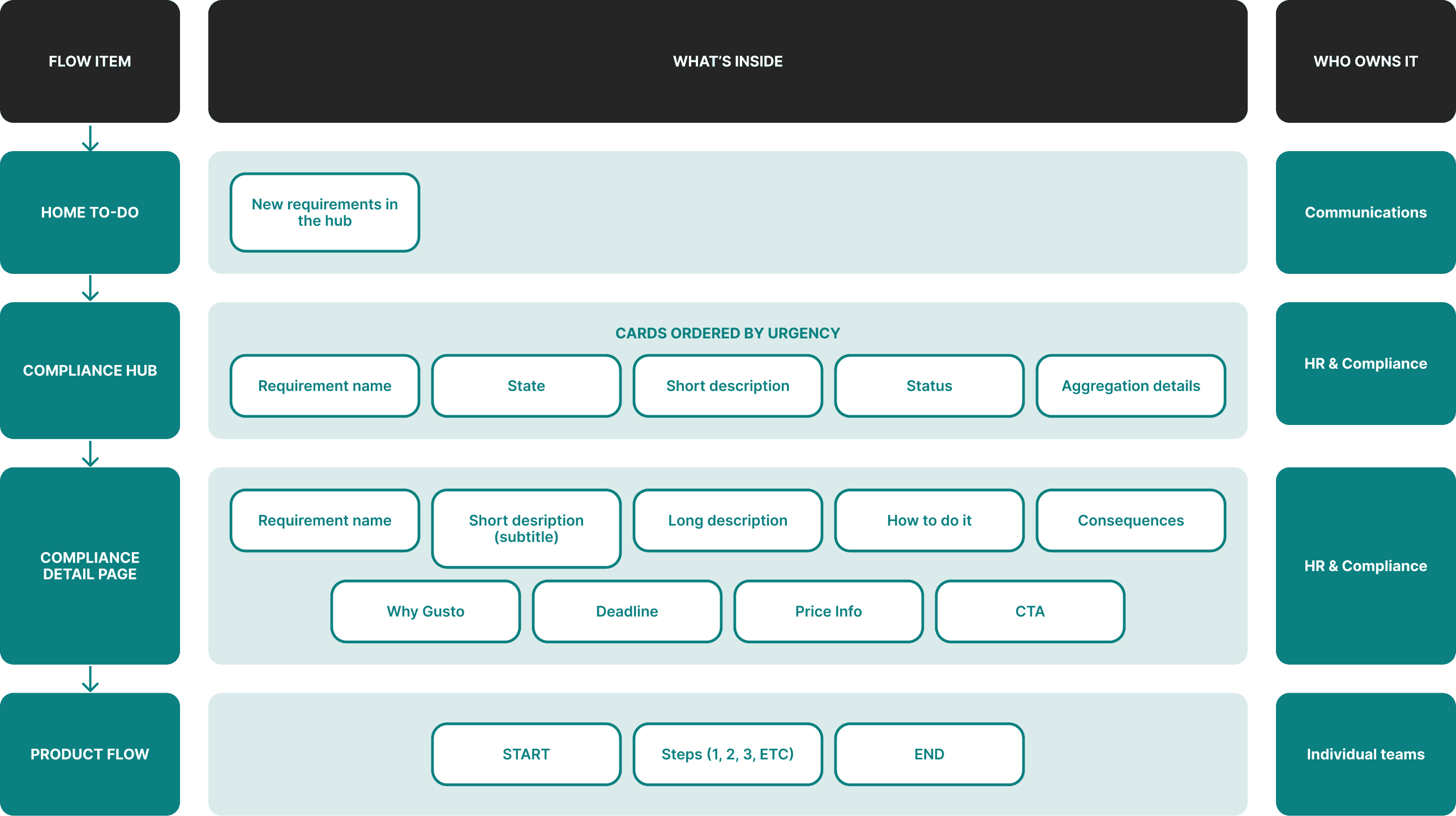
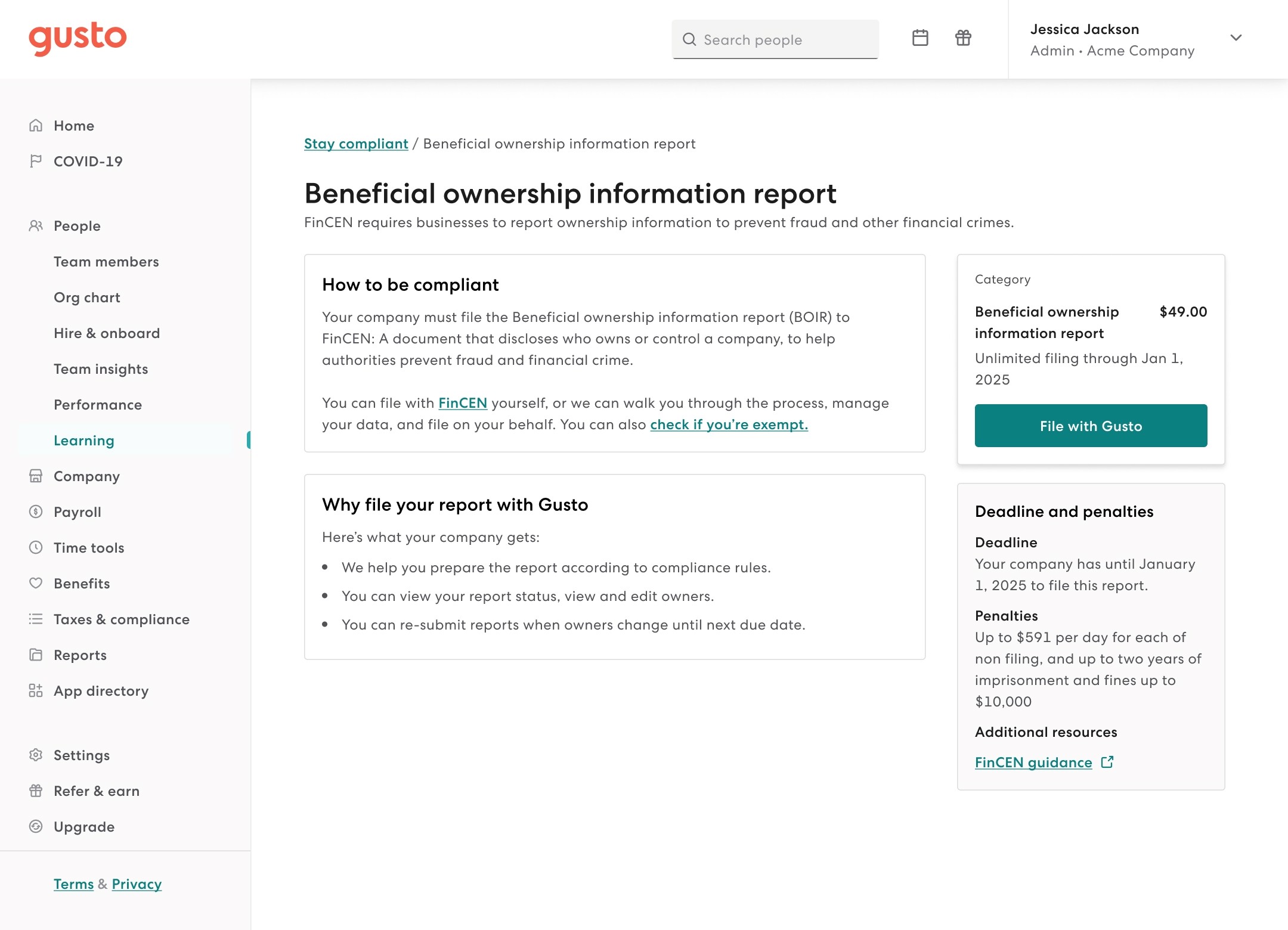
Once key teams onboarded their compliance use cases into the new engine, we identified the need for a centralized hub to house requirements, avoiding overload in the Home task system. I mapped the information architecture and defined the informational pieces we needed to bring customers from a Home tasks to the hub, and into in-product flows for understanding and acting on compliance.
Using the home screen task system to communicate compliance became unsustainable. We launched stage 2 of this project: The creation of a centralized hub to house all alerts and their progress, avoiding overload in the Home task system. I mapped the information architecture and defined the informational pieces we needed to bring customers from a Home tasks to the hub, and into in-product flows for understanding and acting on compliance.
Caption
Info architecture


Exploratory concepts
Compliance hub explorations
Early explorations focused on organizing information, and making sure we set clear expectations on what customers needed to do, Vs. requirements already handled by Gusto.
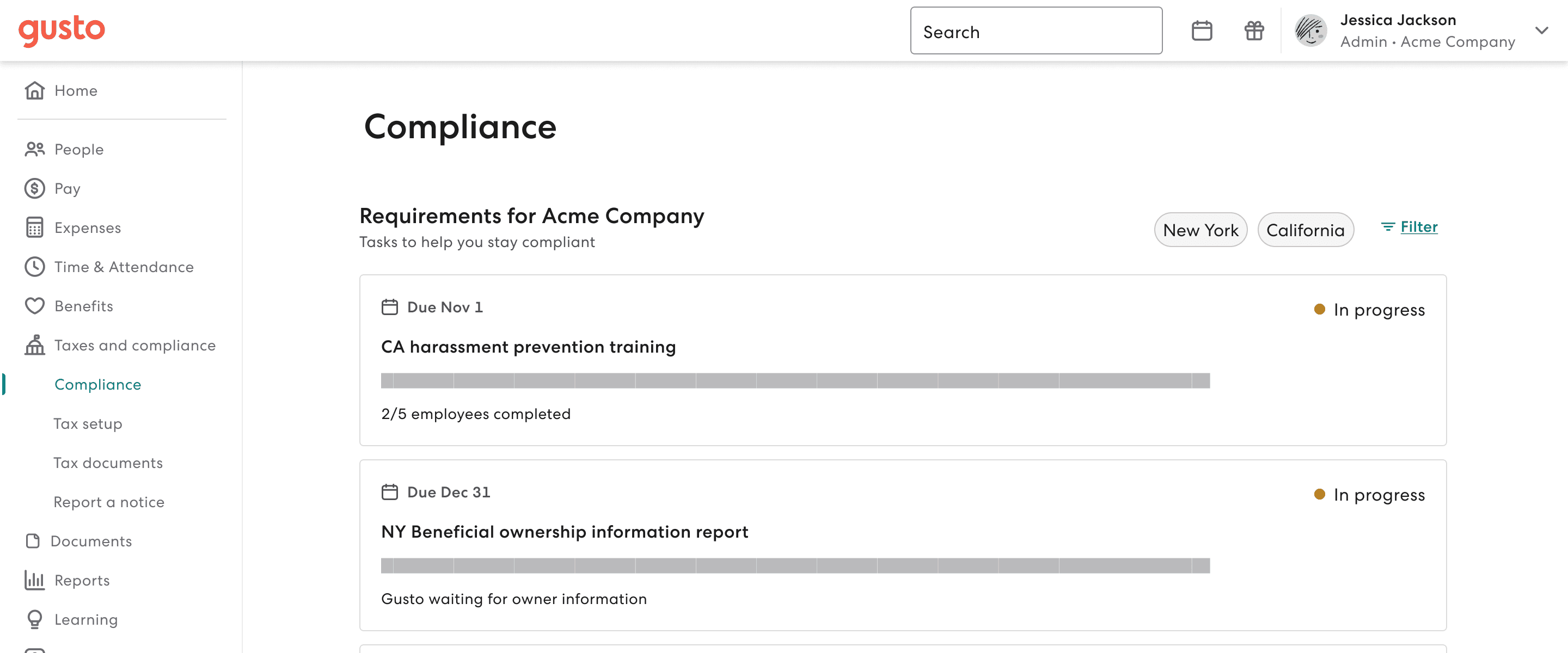
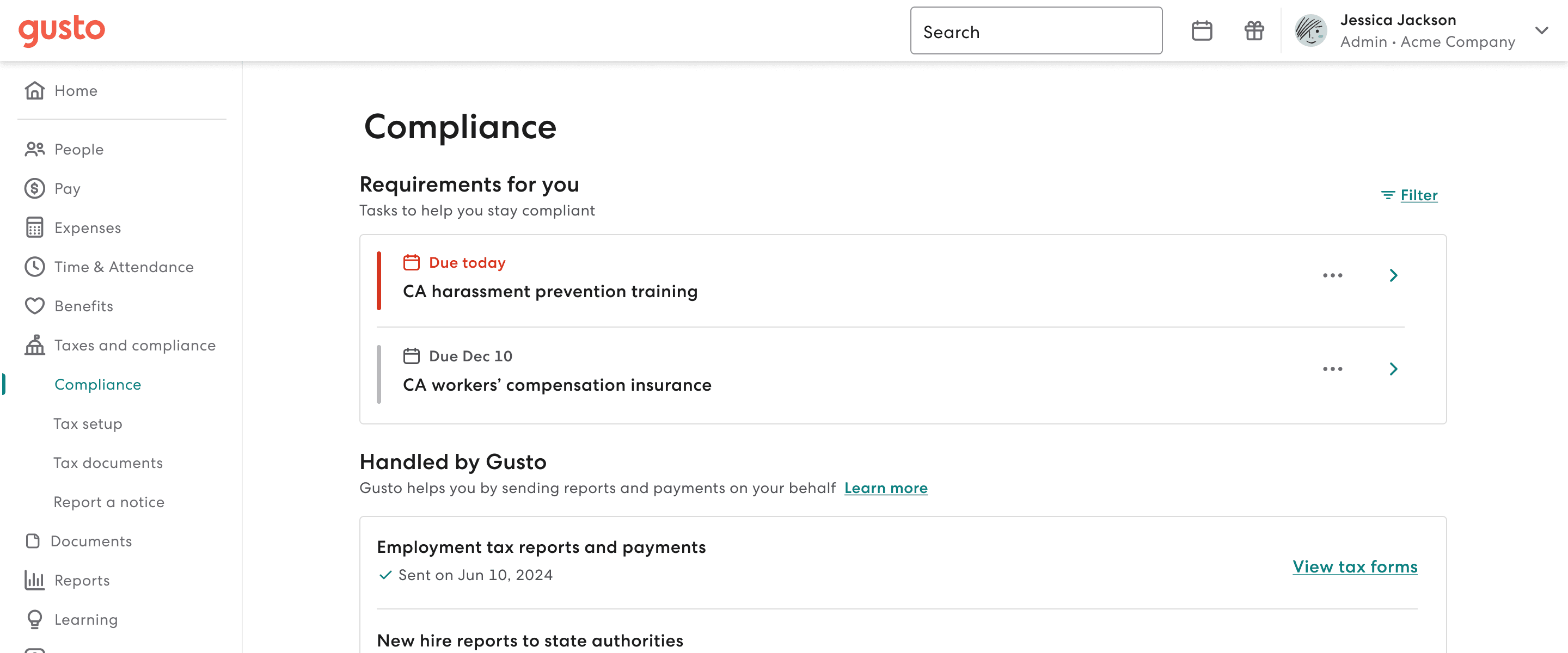
Some options were: Organizing compliance by type (payroll, HR, benefits, recurrently handled by Gusto) or by a combination of urgency and State, which is an industry standard we wanted to follow.
Organize by state
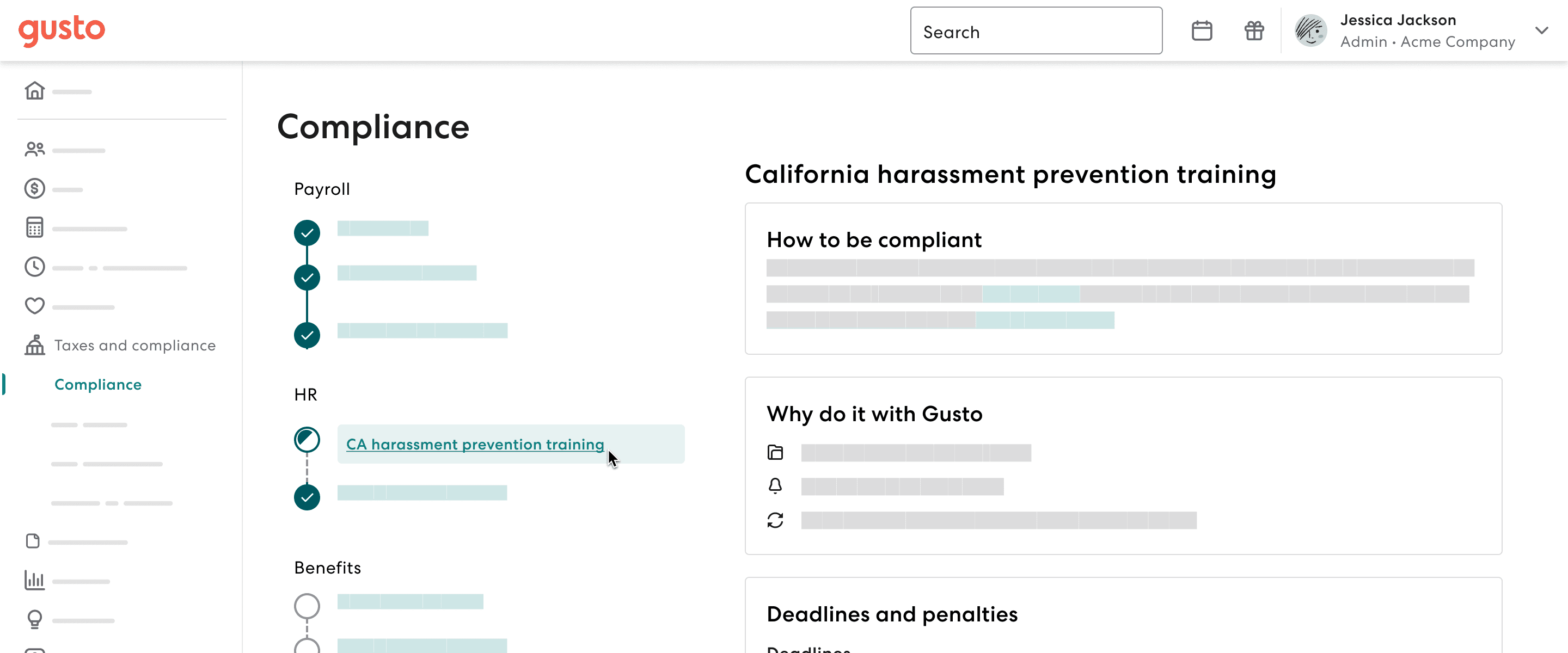
Organize by topic (payroll, benefits, HR, etc.)


Organize by owner (admin Vs handled by Gusto)


Final hub
In the final design tasks were organized across 3 tabs that separate active requirements from automated and completed requirements, where tasks were displayed by urgency. Supporting information like "next action by" gave high-level visibility of who owned the task, whether this was in the government's court, on the customer or on Gusto to do the next step.
Caption
From awareness to understanding and final action
Conclusion
The compliance engine is now a shared infrastructure, used across Gusto to power HR, payroll, and benefits compliance alerts and changes.It inspired adoption of compliance UX principles company-wide.
Further empathy studies showed that employers expressed awareness of how Gusto helps with compliance, also reflected in reduced customer support related calls.
The compliance engine is now a shared infrastructure, used across Gusto to power HR, payroll, and benefits compliance alerts and changes.It inspired adoption of compliance UX principles company-wide, and brought a constant stream of revenue to multiple Gusto products and partners (HR trainings, law posters, benefits and insurance providers).
Further empathy studies showed that employers expressed awareness of how Gusto helps with compliance, also reflected in reduced customer support related calls.